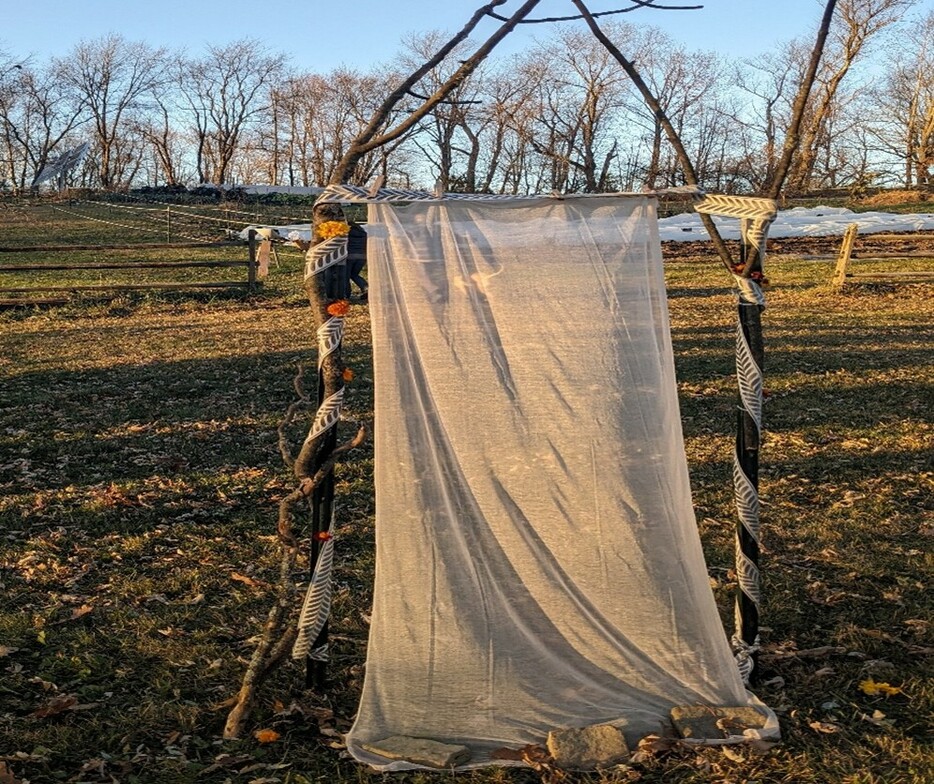
Becoming a Vision of the Afterlife A sermon preached by Rev. Sarah Henkel - All Saints Sunday, Otisville Presbyterian Church
There is a saying attributed to the early Celtic church that says, “Heaven and earth are only three feet apart, but in Thin Places that distance is even smaller.” Celtic Christians understood that the physical world - the one we can see - exists alongside a spirit world, which we cannot see…but that we can sometimes sense, especially in thin places. What are thin places? Maybe your mind immediately has traveled to one: a mountain or river bank where you have experienced the kind of awe that knits together worlds, or perhaps the graveside of a loved one where you remember and connect to a form of their presence that is intangible but undeniably there with you. Thin places are not just geographical but temporal - they may be revealed during certain seasons of the year. Pre-Christian Celts understood this season in the Northern hemisphere to be a time in which the veil between the material and the spirit world to be particularly thin. The Celtic celebration of Samhain on October 31 and into November 1 is rooted in a noticing of what is happening around us here and now in creation. The plants are dying back, the trees are releasing their leaves, the harvests have been gathered in, and the light is fading. We are entering into deepening darkness and our animal bodies know this. If we listen we are being called into quieter rhythms and stillness silent enough to hear from worlds beyond our own. And then there are the thin places that are based not in seasons of the earth but seasons of our lives. There are moments in our lives when we cross over from one reality to the next, we step through a threshold or doorway between worlds. Last year around this time I accompanied a friend of ours at the birth of her third child. Watching a being take their first breath is undoubtedly a thin place. As is being present as someone nears their last breath. When I was a sophomore in high school my Uncle George was nearing death at our family home. He moved in with my family at age 99. He was not a blood relative but a long-time family friend. In his 103rd year he began the dying process. I remember tentatively coming in and out of his downstairs bedroom - which was also our t.v. room - and watching his nearly constant sleep and labored breathing. And I remember other markedly different interactions in which he was suddenly alert again. Most memorably, during these moments of lucidity I recall Uncle George speaking to and about people in the room who I could not see. I was riveted. It turns out these deathbed visions are quite common. Though frequently dismissed in medicalized settings as medicine-induced hallucinations, close observers of these visions note that there is a distinction between the delirium that results from medications or even the dying process itself AND this other category of visions. Chris Kerr, who witnessed a deathbed vision of his father when he, Chris, was just 12 years old, is now a physician dedicating research to these visions that often bring meaning and comfort not just to the dying but to the living who bear witness. Kerr’s research process involves interviewing people experiencing the dying process. They share “the visions feel real and entirely unique compared with anything else they’ve ever experienced. They can begin days, even weeks, before death. Most significant, as people near the end of their lives, the frequency of visions increases, further centering on deceased people or pets. It is these final visions that provide patients, and their loved ones, with profound meaning and solace…. In Kerr’s 2020 book, “Death is but a Dream,” he concludes that the love his patients find in dying often brings them to a place that some call enlightenment and others call God. “Time seems to vanish,” he [writes.] “The people who loved you well, secured you and contributed to you are still accessible at a spiritual and psychological level.” 1 1 What Deathbed Visions Teach Us About Living, Phoebe Zerwick, New York Times, March 12, 2024 Next to these stories of deathbed visions and the meaning they offer, we hold this morning’s passage from the book of Revelation. Revelation literally translates to unveiling so we can read this whole book as a thin place, a door between worlds. It is the compiled visions of John of Patmos who scholars believe was a refugee from Palestine living in Asia Minor. He had experienced the destruction of his home by the Roman Empire during a Jewish uprising. 2 While John’s visions in the book of Revelation can’t be precisely called deathbed visions - we don’t have reason to believe he was actively dying - they are most definitely visions inspired by witnessing death. John saw the suffering of war and the oppressive forces of Empire all around him. He also saw this:
Revelation 7:9-17 After this I looked, and there was a great multitude that no one could count, from every nation, from all tribes and peoples and languages, standing before the throne and before the Lamb, robed in white, with palm branches in their hands. They cried out in a loud voice, saying, “Salvation belongs to our God who is seated on the throne, and to the Lamb!” And all the angels stood around the throne and around the elders and the four living creatures, and they fell on their faces before the throne and worshiped God, singing, “Amen! Blessing and glory and wisdom and thanksgiving and honor and power and might be to our God forever and ever! Amen.” Then one of the elders addressed me, saying, “Who are these, robed in white, and where have they come from?” I said to him, “Sir, you are the one that knows.” Then he said to me, “These are they who have come out of the great 2 Elaine Pagels, Revelations: Visions, Prophecy, & Politics in the Book of Revelation ordeal; they have washed their robes and made them white in the blood of the Lamb. For this reason they are before the throne of God, and worship him day and night within his temple, and the one who is seated on the throne will shelter them. They will hunger no more, and thirst no more; the sun will not strike them, nor any scorching heat; for the Lamb at the center of the throne will be their shepherd, and he will guide them to springs of the water of life, and God will wipe away every tear from their eyes.” John wrote down his apocalyptic visions to be shared with 7 communities of followers of Jesus. He shared these visions as a warning about the present and advancing violence of the Roman Empire in his days. And he shared these visions as comfort and strength for those who would suffer most as small, marginalized faith communities marked as “other” and “disposable” by the forces of Empire. Reading today’s selection from John’s vision in the context of this season, a season marked by thin places, unveiling, porousness between this world and the world beyond our sight opens us to hear John’s words not just as a beautiful future vision, not just as a promise to be received in the afterlife, but as a call to a distinctive way of living here and now as followers of Christ. In this passage we witness who and how God loves in the fullness of time: those who mourn are comforted, those who were hungry and thirsty are fed, those who were unsheltered are offered full protection, those denied fullness of life - through the forces of hatred or exclusion - now drink from the springs of the water of life. When we have the courage to love as God loves here and now. When we enact the blessings of John’s vision here and now we become thin places ourselves. In her writings about Celtic spirituality, Laura Cole writes “The Celts understood that the sacred is not reserved for grand monuments. It lives wherever love was strong enough to leave a mark on the land.” 3 I would add that it lives wherever love was strong enough to leave a mark on us. At the end of October I participated in a training to accompany people at the end of life. There were 96 people who signed up for the training. The vision of these trainings is to equip people with the skills to be present to anyone who would like the presence of another person as they cross the threshold from this world to the next. The organization I trained with - INELDA - has trained thousands of people, including people living in prison One of the resources they shared was a “documentary called Prison Terminal, directed by Edgar Barens…The documentary depicts the last days of an inmate, Jack Hall, in a hospice program in an Iowa maximum security prison. The film
3 https://celticmeanderings.com/thin-places/
showed a group of inmate volunteers taking care of Jack with an amazing degree of kindness and compassion. They massaged his back when he had been lying on it for a long time. They washed and shaved him when he couldn’t do that for himself. At one point the primary inmate volunteer, a black man, leaned down to kiss Jack on the cheek and tell him he loved him. Jack, responded in kind, even though he had once [clung tightly to racist beliefs.] When Jack died the state required that he be fingerprinted. The nurse who was there at the time made a point of washing the ink off his fingers, saying: “They come in here with ink on their fingers, but I make sure they leave with all the ink washed away.” 4 God will wipe away every tear from their eyes…and the ink from their fingertips. Love - powerful love, uninhibited by the value judgments of Empire - is our foretaste of John’s vision. May we live as ones ushering God’s kin-dom across the threshold into today.
4 https://inelda.org/resurrecting-a-prison-doula-program/